
Insights
The Tech-Enabled Playbook: How Private Equity is Redefining Value Creation in 2026
February 13, 2026 · M&A Advisory · PE Value Creation
Bass Zanjani · Managing Director

The playbook has changed. For decades, private equity value creation followed a predictable formula: layer on leverage, cut costs, optimize working capital, and rely on multiple expansion. That model isn't dead, but it's no longer sufficient. In 2026, the firms winning deals and commanding premium exits are the ones who've adopted a different approach.
Technology is now the core of the investment thesis.
If you're still treating digital transformation as a post-close "nice to have" or relegating AI to your IT department's wish list, you're already behind. The most sophisticated PE firms, independent sponsors, and family offices have changed how they think about value creation. They still buy businesses and make them more efficient. They also turn them into tech-enabled companies that grow faster, scale more effectively, and exit at higher multiples than traditional operators achieve.
Here is what is working right now, and why firms are moving away from the old playbook.
From Financial Alpha to Operational Alpha
For years, PE returns were driven primarily by financial engineering. You'd acquire a business at 6x EBITDA, add some debt, trim expenses, and sell at 8x. The value creation came from the cap table and the balance sheet more than the actual operations.
That era is mostly over. Higher interest rates ended the period of cheap debt. Multiples compressed. Sellers got smarter about stripping out one-time adjustments before going to market. The easy financial gains have already been taken.
Operational alpha driven by technology is replacing it.

The firms generating outsized returns in 2026 are the ones building genuine operating improvements into their portfolio companies using AI, data analytics, and digital infrastructure. Cutting headcount is only part of it. They are redesigning how the business makes money, serves customers, and scales operations. They are also doing it faster than before, because technology gives them capacity that people and processes alone never could.
According to recent data, 65% of PE firms now mark AI as a top priority, and more than half of middle-market portfolio companies have active AI initiatives underway. These firms have moved from experimenting with AI to deploying it at scale.
The Digital-First PE Playbook
Here's what the new playbook looks like in practice.
Pre-Deal: Tech Due Diligence as Investment Thesis
Smart buyers are now running technology assessments during diligence with the same rigor they apply to QofE. They're asking: What's the digital maturity of this business? Can the tech stack support growth? What's the data infrastructure look like? Are there AI-ready systems in place or will we need to rip and replace everything?
The purpose goes beyond an IT audit. It is to understand whether the business can absorb the operational improvements you're planning to drive returns. If the answer is no, that's either a valuation discount or a deal-breaker.
Day One: Infrastructure Before Optimization
The mistake most firms make is trying to bolt AI onto broken systems. The winners are investing in core infrastructure first: modern ERP systems, clean data pipelines, cloud migration, and cybersecurity frameworks. Yes, this costs money upfront. But it's the foundation that makes everything else possible.
In 2026, the most disciplined firms are budgeting 100-day infrastructure sprints post-close before they even think about deploying AI at scale. The systems and data come first, and the AI deployment follows.
Value Creation: AI-Driven Revenue Growth and Margin Expansion
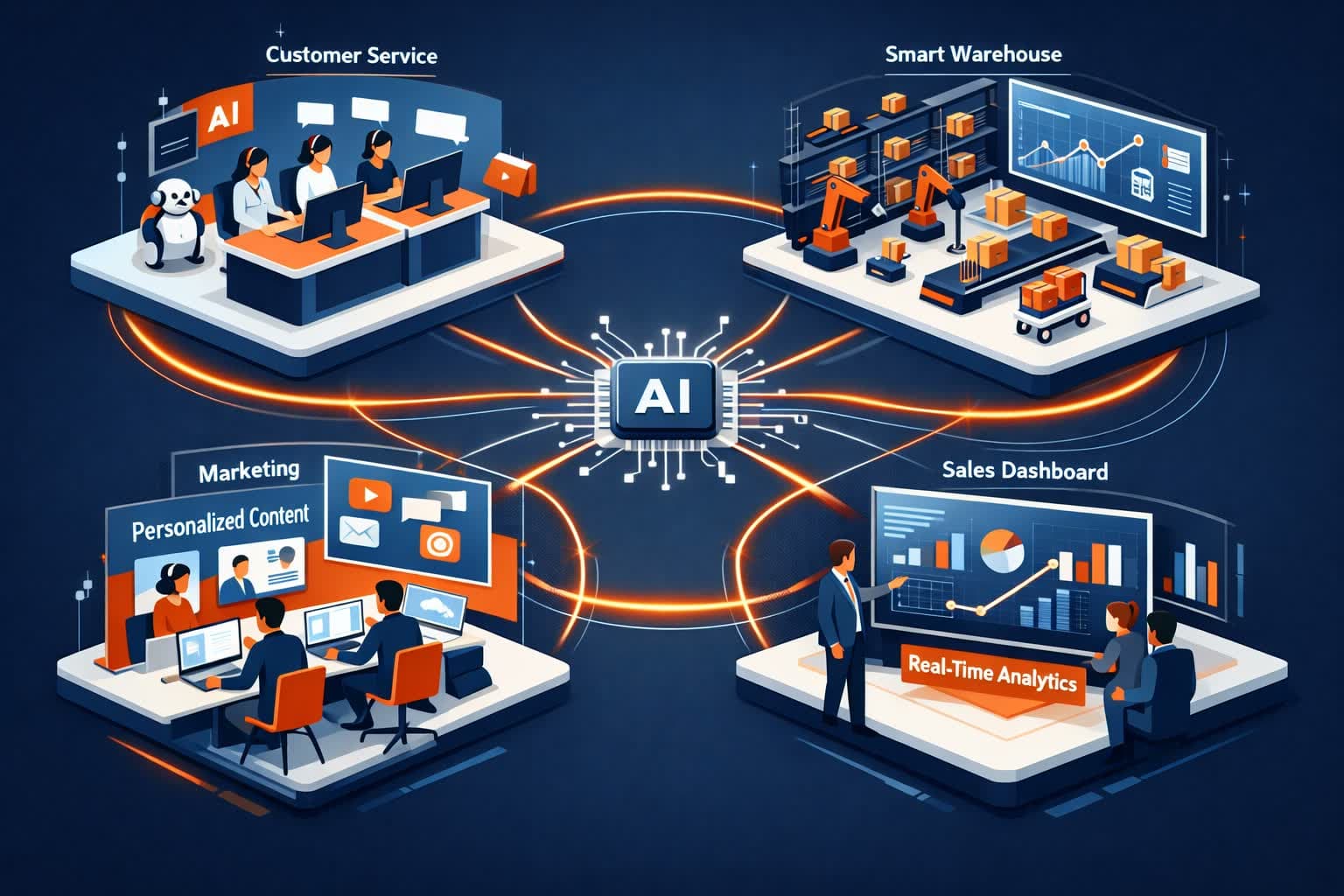
Once the infrastructure is in place, AI can do more than cut costs. It drives top-line growth through better customer targeting, dynamic pricing, personalized marketing, and sales enablement. It also expands margins through supply chain optimization, predictive maintenance, and automated workflows that used to require large teams.
This is the shift from tactical AI (automate one task) to strategic AI (transform the business model). The companies getting this right are seeing 20-30% improvements in key metrics within 12-18 months.
High-Impact AI Use Cases in Portfolio Companies
Here are the AI applications we're seeing generate real ROI in portfolio companies right now:
Sales and Marketing
AI-powered lead scoring and customer segmentation are helping sales teams focus on high-probability opportunities instead of untargeted outreach. Marketing teams are using generative AI to personalize content at scale and optimize ad spend in real time. One portfolio company we're familiar with increased conversion rates by 40% just by deploying better targeting algorithms.
Supply Chain and Operations
Predictive analytics are changing inventory management and demand forecasting. Instead of holding excess safety stock or facing stockouts, companies are using AI to optimize inventory levels dynamically based on real-time signals. The result is better working capital and higher service levels at the same time.
Predictive maintenance in manufacturing and logistics is another huge win. Instead of scheduled downtime, AI monitors equipment health and flags issues before failures occur. Less downtime, lower repair costs, and better asset utilization.
Customer Support and Service
Agentic AI customer support now goes beyond chatbots. Modern AI agents can handle complex service requests, troubleshoot technical issues, and escalate to humans only when necessary. This drives both cost savings (fewer support staff needed) and better customer experience (24/7 availability, faster resolution times).
Finance and Back Office
Automated accounts payable, receivable, and reconciliation processes are freeing up finance teams to focus on strategic analysis instead of data entry. AI-powered financial forecasting is giving CFOs better visibility into cash flow and performance trends. This is where the "Operator CFO" model is most useful: finance leaders who understand both the numbers and the technology driving them.
As Bass Zanjani, Managing Director of Crescent Capital Advisors, explains it: "We're past the point where technology is something you layer onto a business after the fact. The firms winning right now are the ones who see tech as the core of the investment thesis from day one. If your value creation plan doesn't have a detailed technology roadmap with specific ROI targets, you're not serious about alpha generation anymore. The market has moved on."
The Rise of the Operator CFO and Quant PE Firms
The talent profile at PE firms is changing fast. The traditional finance-focused partner model is giving way to hybrid operators who understand both capital markets and technology deployment.
Operator CFOs
The best portfolio company CFOs in 2026 are strategic operators as well as accountants. They can evaluate technology investments, build business cases for AI implementations, and work alongside CIOs to prioritize digital initiatives. They understand unit economics, data infrastructure, and how technology impacts both the P&L and the balance sheet.
They drive decisions about whether to build or buy software, how to structure SaaS contracts, and where to deploy capital for maximum operational leverage.
Quant PE Firms
A new breed of PE firms is emerging that looks more like tech companies than traditional financial sponsors. They're building centralized data science teams, creating repeatable AI playbooks that can be deployed across multiple portfolio companies, and hiring machine learning engineers alongside deal professionals.
These "Quant PE" firms are establishing AI Centers of Excellence at the fund level. Instead of each portfolio company building the same tools separately, they're sharing infrastructure, tools, and best practices across the entire portfolio. The result is faster deployment, lower costs, and better outcomes.
Real-Time Performance Visibility as Competitive Advantage
The best-performing PE firms in 2026 have moved beyond monthly board reports and quarterly reviews. They're operating with real-time performance dashboards that give them continuous visibility into portfolio company metrics.

Modern data platforms can aggregate KPIs across the entire portfolio and surface insights immediately. This means fund managers can spot problems early, identify best practices from top performers, and make faster decisions about where to allocate resources.
The goal is strategic agility rather than micromanagement. When you can see trends developing in real time instead of discovering them 30 days later in a board deck, you can act while there's still time to make a difference.
The firms that have built this capability are outperforming on both growth and risk management. They're catching revenue deterioration before it becomes a crisis. They're spotting operational bottlenecks and fixing them immediately. They're identifying which AI initiatives are working and which ones need to be killed.
What This Means for Your Next Deal
If you're evaluating a platform investment right now or thinking about your value creation strategy for existing portfolio companies, here's what you need to be doing:
Make technology as important as financials in diligence. Don't wait until after close to discover the company is running on legacy systems held together with workarounds.
Budget for infrastructure. Plan for a 100-day sprint to get systems, data, and security foundations in place before you start deploying AI and analytics.
Hire for the new model. Bring in Operator CFOs and technology-savvy operational leaders who can execute on digital transformation.
Build or buy AI capabilities. Either develop a centralized team at the fund level or partner with firms that have proven playbooks for portfolio company AI deployment.
Establish real-time visibility. Invest in data platforms that give you continuous performance monitoring across the portfolio.
Think exit from day one. Buyers in 2026 are paying premiums for tech-enabled businesses with demonstrable AI capabilities and clean data infrastructure. Build that story from the beginning.
Conclusion
Financial engineering and leverage will always be part of the PE toolkit. Technology has replaced them as the primary driver of alpha.
The firms that understand this, and are building the capabilities to execute on it, are writing the checks at premium valuations. They are also exiting at higher multiples than their competitors. The firms still operating with 2015 playbooks are being outbid on quality deals and are left with assets that are harder to improve and harder to exit.
The shift is already happening. Each firm has to decide whether to be part of it.
Want to discuss how to integrate technology-driven value creation into your investment strategy? Reach out to our team at Crescent Capital Advisors. We help PE firms, independent sponsors, and family offices build smarter, more competitive portfolios for the 2026 market and beyond.
Working through a version of this?
A 30-minute call about your situation. We will not present slides or a sales pitch.