

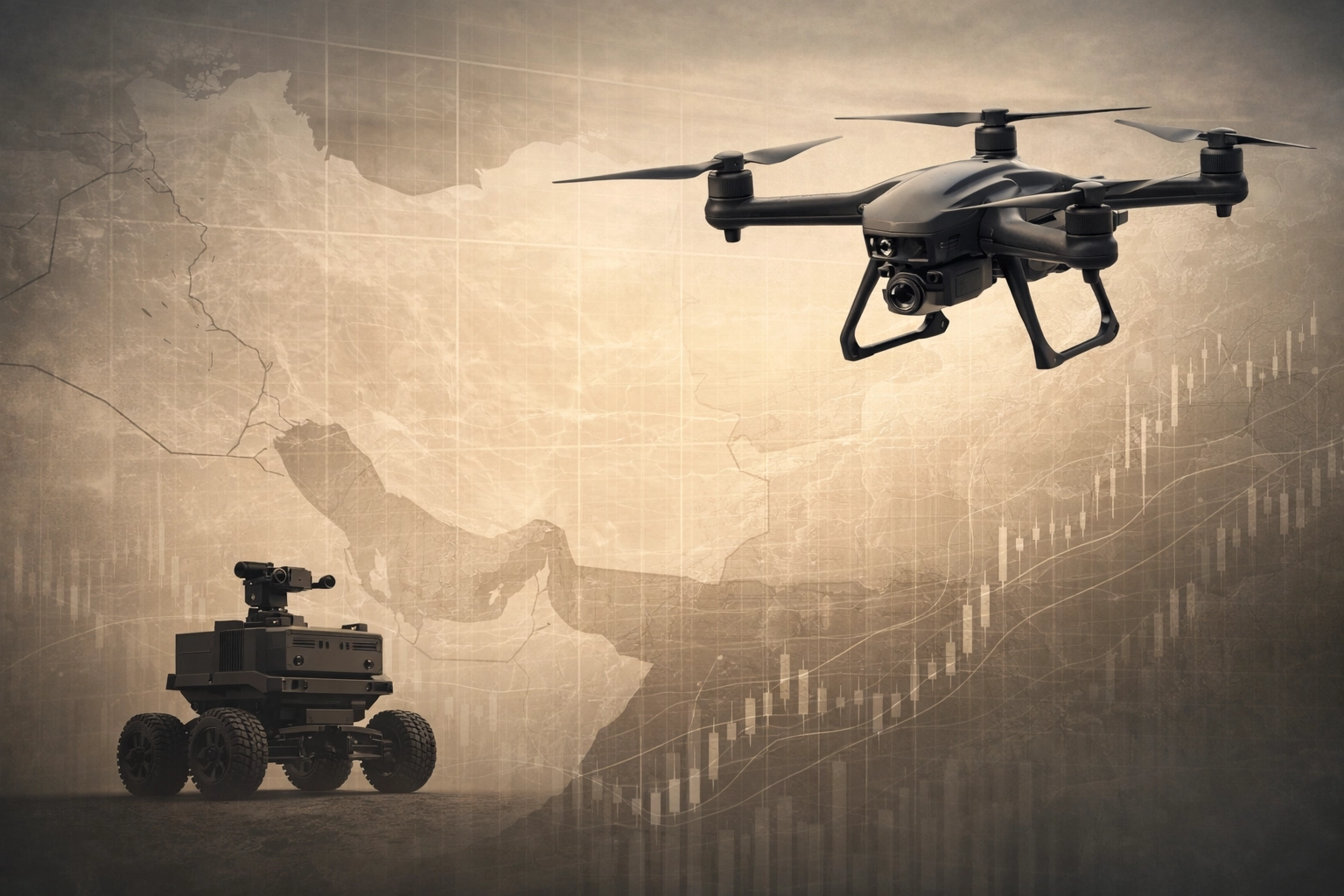
Modern combat is changing fast, and it is not just about bigger budgets or better hardware—it is about asymmetric advantage. This article is for informational purposes only and does not constitute investment advice. Cheap drones, software-defined sensors, and autonomous systems are rewriting the rules for how nations defend critical infrastructure, maritime lanes, and forward positions. For investors and acquirers, this shift is reshaping where value is created, how exits are underwritten, and what defensible really means in aerospace and defense.
March 2026’s Operation Epic Fury (with US and Israeli strikes against IRGC infrastructure and naval assets in the Gulf) is a timely example. The bigger story is broader than any single theater: robotics, drones, and autonomy are no longer adjacent to defense—they are becoming the core of how capability is created, scaled, and defended. In practical terms, we are watching asymmetric warfare scale: low-cost unmanned systems disrupting high-cost platforms and pushing procurement toward autonomy, detection, and Counter-UAS at speed.
The Math of Asymmetric Warfare: The Cost Exchange Ratio Problem
One of the most important takeaways from the early weeks of Operation Epic Fury is not just tempo—it is economics. Iran’s playbook has leaned heavily on low-cost UAVs, loitering munitions, and good-enough drones designed to pressure and saturate traditional defenses. This is where the cost-exchange ratio becomes the story: if a drone costs thousands (or tens of thousands) and the interceptor costs millions per shot, defenders can win tactically while losing financially over time.
That mismatch is accelerating demand for systems that bring the cost-per-engagement way down, including:
- Counter-UAS (C-UAS) soft-kill: jamming, spoofing, protocol exploitation, and navigation denial
- Hard-kill options that scale: lower-cost interceptors, rapid-fire guns, and emerging directed-energy approaches
- Autonomous detection and targeting that reduces the human-in-the-loop bottleneck when volume spikes
For financial sponsors, this is one of the clearest directional signals inside aerospace and defense: capital is reallocating toward technologies that solve the cost-exchange ratio at scale, not just headline platforms. In practice, that often means subscale, founder-led robotics, sensor, and autonomy businesses that can be professionalized, consolidated, and ultimately positioned as strategic assets to primes or sovereign buyers.
The Autonomy Gap: Supply Chains, Sensors, and a Fragmented Drone Industrial Base
As US and allied inventories are stressed by regional threats, it is not only munitions that matter. The bigger tell is an autonomy gap: demand is rising for drones, robotics, sensors, and the electronics stack that makes unmanned systems viable in contested environments. At Crescent Capital Advisors, we have been tracking how this shift is creating more durable revenue visibility for companies that can scale:
- Airframes and propulsion for attritable drones
- ISR payloads (EO/IR, radar, RF) and stabilized gimbals
- Navigation resilience (anti-jam, alternative PNT, terrain matching, inertial improvements)
- Edge compute and comms for operating in degraded, denied, intermittent, or limited-bandwidth environments
Many of these niches remain highly fragmented, with specialized, subscale suppliers that are natural consolidation candidates for sophisticated sponsors. At the same time, the diligence bar is high: export controls, program risk, and customer concentration can all be decisive. This combination of fragmentation plus complexity is exactly where specialist M&A advisory can help sponsors separate durable industrial-base assets from single-program stories.
We have previously discussed how history teaches us about investing during Middle East conflicts, but today’s volatility adds a layer of technological urgency. The replenishment cycle is not just about replacing stockpiles; it is about replacing them with autonomous, cheaper to deploy capability that holds up under saturation attacks.
Historical Resilience and What is Different Now
While no two conflicts are identical (and past performance never guarantees future results), historical data and event studies have often suggested positive abnormal returns for defense stocks during periods of active conflict and heightened geopolitical risk—for example, around the Gulf War era and the post-9/11 period. At the broader index level, the S&P 500 has often seen a short-term drawdown around the onset of major military interventions, but has typically recovered within a relatively short window. Within defense and aerospace, however, returns have historically been highly dispersed, which puts a premium on rigorous target selection and underwriting.
What is different now is where the potential alpha tends to show up. The old playbook was heavy metal (tanks, ships, big-ticket platforms). The modern playbook is increasingly silicon and software: robotics, drones, autonomy, sensor fusion, and AI-enabled detection and targeting. Put simply, markets are not just pricing defense spend—they are pricing the evolution of defense technology.
Geopolitical Shifts: UAE, Saudi Arabia, and Energy Security
The conflict is not happening in a vacuum. The involvement of the UAE and Saudi Arabia has been pivotal, particularly in securing the Strait of Hormuz and maintaining regional energy security. This geopolitical alignment is reshaping trade routes, capital flows, and M&A opportunities throughout the MENA region.
For family offices and institutional investors, the stability provided by advanced defense systems is what allows for continued investment in other sectors. If the energy corridor is secure, the rest of the market can breathe. This is one reason we are seeing increased M&A growth in the MENA region for 2026, even amid active conflict. Security is not just a military goal; it is an economic prerequisite, and it is also broadening the buyer universe for mid-market defense and industrial-tech assets—particularly from Gulf strategic and sovereign capital.
How Sponsors Are Transacting in This Space
For mid-market PE firms and family offices, the Big Primes are not the only way to participate. Some of the most compelling opportunity sits in the robotics and autonomy layer that both enables and defends against low-cost drone warfare. We see three patterns in how sophisticated sponsors are transacting:
- Minority and growth deals into founder-led autonomy, AI, and C-UAS software companies where capital accelerates productization and go-to-market
- Buy-and-build strategies around specialized subsystems (sensors, RF, rugged compute, navigation) that can be integrated into broader mission systems over time
- Carve-outs from larger industrial and defense groups where sponsors can modernize the tech stack, professionalize operations, and re-position the asset toward higher-growth programs
Within that, several subsectors stand out:
- Counter-UAS (C-UAS): Ground zero for the cost-exchange ratio problem. Attractive targets often combine multi-sensor detection (radar, EO/IR, passive RF), sensor fusion, and a mix of soft-kill and hard-kill defeat options, with a growing share of recurring software and services revenue.
- Robotics and Autonomous Systems: Attritable UAVs, unmanned ground vehicles (UGVs), unmanned surface vessels (USVs), and the autonomy stack that coordinates them (mission planning, middleware, safety layers, edge compute). These are no longer nice-to-have—they are how capability scales without scaling headcount, which supports both strategic and sponsor demand.
- Swarm Robotics and Coordination Software: Swarms flip engagements from one target, one interceptor to many cheap targets, many simultaneous decisions. Winners here tend to be IP-heavy and asset-light, building reliable swarm comms, decentralized coordination, and resilient behaviors under jamming and intermittent links.
- AI-Driven Drone Detection and Targeting: The next wave is the AI layer—real-time anomaly detection, multi-sensor fusion, automated classification, and cueing that shrinks time-to-engagement. This brain of the system is one reason private equity is chasing tech so aggressively.
- Autonomy Supply Chain (picks and shovels): Semiconductors, RF components, batteries, motors, sensors, and ruggedized compute. As nations prioritize domestic and friend-shored production, subscale suppliers can become strategic quickly—often before public markets fully price that in.
Risk, Responsibility, and the Structural Shift
One of the biggest misconceptions is that growth in defense-adjacent technology ends when a specific operation ends. In reality, we are seeing a structural shift: global budgets are moving from episodic response to permanent strategy, with modern combat capabilities embedded into long-term planning. National security is being redefined to include cyber defense, energy security, supply chain integrity—and increasingly, autonomy and Counter-UAS.
Key risks sponsors have to underwrite include regulatory and export-control risk, program and budget risk, and reputational risk. Investors are searching for sticky revenue with government backing—multi-year programs, sustainment, and mission-critical technology that sits at the center of modern deterrence—but those attributes only matter if the underlying risk profile is properly understood.
Looking Ahead: The Tech Enabled Playbook
As we move deeper into 2026, the integration of AI and autonomous systems into the defense landscape will only accelerate. The Tech Enabled Playbook we often discuss is becoming the standard for value creation in this sector, from revenue growth to margin expansion and exit positioning. Whether it is redefining value creation through technology or navigating the complexities of deal strategy for family offices, the goal remains the same: protection of capital through the precision of investment.
The conflict with Iran is a sobering reminder of the volatility of our world, but it also highlights the critical importance of the defense sector in maintaining the global order. For investors, the opportunity is to support innovations that provide both protection for our interests and precision for our portfolios.
At Crescent Capital Advisors, we offer specialized buy-side expertise and a retained buy-side search for growth capital investors interested in the defense sector. If you are looking to navigate this evolving landscape and identify high-impact opportunities, we invite you to reach out to our team to discuss how our strategic advisory can support your goals.