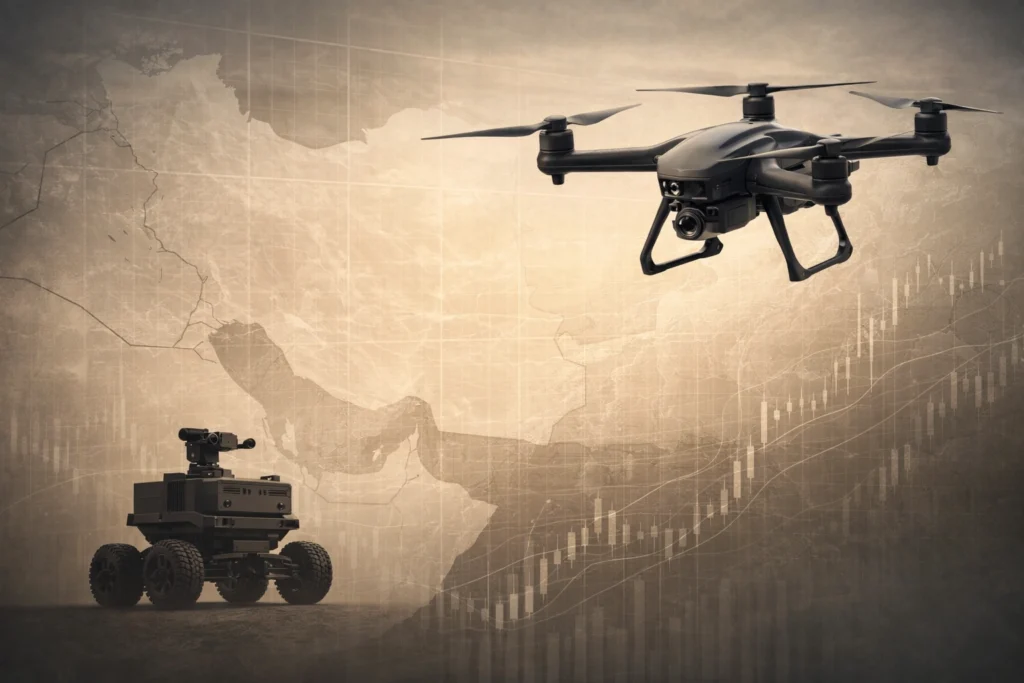


If you’ve spent any time looking at a Bloomberg terminal or scrolling through Reuters lately, you’ve probably noticed that the geopolitical thermostat is cranked up to a "sweaty palms" level. When tensions flare in the Middle East, the knee-jerk reaction for many investors is to look for the nearest exit sign. It’s understandable: war is tragic, unpredictable, and creates the kind of uncertainty that capital markets generally loathe.
However, as our Board Advisor, Bass Zanjani, often points out, there is a distinct difference between "headline risk" and "fundamental market destruction." While the news cycle moves at the speed of light, the history of capital markets moves with a surprisingly predictable rhythm.
At Crescent Capital Advisors, we believe in looking at the data rather than the drama. If we look back at the last fifty years: from the 1973 oil embargo to the current 2023-2026 regional tensions: a clear pattern emerges. Markets are resilient, often pricing in the "worst-case scenario" long before it actually happens.
In this deep dive, we’re going to look at how capital markets actually fared during previous Middle Eastern conflicts and what that means for your portfolio today.
The Anatomy of a Geopolitical Shock
When a conflict breaks out, the market usually follows a standard script. First, there is the "Shock Phase." This is the initial 10-15% equity dip that makes everyone question their life choices. We saw this during the initial stages of the Iraq War and again in the early days of the 2023 escalations.
But here’s the kicker: history shows that these dips are almost always temporary. According to analysis from Invesco and the Financial Times, of the 54 major crisis events since 1907, the Dow Jones Industrial Average fell an average of 7.1% during the crisis itself, but posted an average gain of 9.7% in the six months that followed.
Why? Because uncertainty is the real enemy. Once the conflict begins, the "uncertainty premium" begins to fade. Markets stop wondering if something will happen and start calculating the actual economic impact. Usually, that impact is far less than the doomsday scenarios predicted on cable news.

1973: The Year the Pump Ran Dry
The 1973 Oil Crisis remains the "Big Bad" of Middle Eastern market history. When the OAPEC (Organization of Arab Petroleum Exporting Countries) proclaimed an oil embargo in response to the Yom Kippur War, oil prices didn't just rise: they quadrupled, jumping from $3 to nearly $12 per barrel.
This wasn't just a market dip; it was a fundamental shift in the global economy. It led to stagflation and a prolonged bear market. However, 1973 is often cited as an outlier because the world was far more dependent on Middle Eastern oil then than it is now. Today, with the rise of U.S. shale and diversified energy portfolios, the "oil weapon" has lost much of its edge.
Even so, the lesson from 1973 remains: the severity of a Middle Eastern conflict’s impact on the market is directly proportional to its impact on energy supply chains. If the oil flows, the S&P 500 usually follows.
The Gulf War and the Iraq War: The "V-Shaped" Reality
Fast forward to 1990. When Iraq invaded Kuwait, the S&P 500 dropped about 15%. Oil spiked, and consumer confidence cratered. But as soon as the U.S.-led coalition launched "Operation Desert Storm" in early 1991, the market took off like a rocket. The uncertainty was gone, the mission was defined, and the recovery was swift.
The 2003 Iraq War followed a similar, if slightly more complex, trajectory. Before the invasion, oil prices jumped by about $10 almost overnight as markets feared a total disruption of Iraqi production. Yet, despite the long-term geopolitical quagmire that followed, the S&P 500 actually gained over 20% in 2003.
As Bass Zanjani often reminds our clients at Crescent Capital Advisors, the market is a forward-looking machine. By the time the first boots hit the ground, the "war" has often already been priced in.
The Arab Spring and the 2023-2026 Tensions
The 2011 Arab Spring proved that localized instability doesn't always translate to global market contagion. While countries like Egypt and Libya saw massive domestic upheaval, the global MSCI World index remained remarkably stable. The focus for institutional investors was less on the political change and more on the continuity of the Suez Canal and regional oil pipelines.
In the current era (2023-2026), we’ve seen a recurring theme of "contained escalation." While headlines suggest a region on the brink, the capital markets have been surprisingly bullish. In fact, global stocks gained approximately 30% over the last year despite ongoing regional tensions.
The primary reason? The global economy has become "anti-fragile." Markets have learned to discount regional noise unless it threatens a total shutdown of the Strait of Hormuz. Currently, with oil hovering in the $70-$80 range, the inflationary impact remains manageable: adding only about 0.2 to 0.3 percentage points to global inflation baselines.

Sector Winners: Defense and Energy
If you’re looking to hedge against regional instability, history points to two clear winners: Defense and Energy.
- Defense: Companies like Lockheed Martin, Northrop Grumman, and Raytheon often act as a natural hedge. When regional tensions rise, national defense budgets tend to follow. During the height of Middle Eastern conflicts, the aerospace and defense sectors have historically outperformed the broader S&P 500 by significant margins.
- Energy: This one is a bit of a double-edged sword. While high oil prices can hurt the overall economy, they are a boon for the energy sector. We’ve seen mid-term recoveries in energy stocks even when the rest of the market is flat, provided the conflict keeps supply tight.
The 12-18 Month Rule
If there is one takeaway from the last 50 years of data, it’s this: The market typically prices in conflict within 12 to 18 months.
Investors are incredibly efficient at adapting to "the new normal." Whether it's the Suez Crisis, the Iran-Iraq War (which, ironically, occurred during one of the strongest bull markets of the 1980s), or the current tensions, the pattern holds. The initial shock gives way to a period of adaptation, followed by a focus on corporate earnings and domestic economic policy.

Final Thoughts: Buying the Dip or Holding the Line?
So, what should you do when the headlines get loud?
First, breathe. Second, look at the historical precedent. Aside from World War II, no major conflict since 1925 has resulted in a sustained, long-term bear market for U.S. equities. The "buy the dip" mentality isn't just a meme; it’s a strategy backed by decades of data from the likes of Bloomberg and Reuters.
At Crescent Capital Advisors, we focus on the long game. Whether you are looking for buy-side-advisory or managing a family-office, the key is to avoid making emotional decisions based on a 24-hour news cycle.
Geopolitics is a variable, but market resilience is a constant. If you’re feeling the heat from the current global climate and want to discuss how to position your firm or portfolio for the long term, feel free to check out our insights or reach out to us directly through our contact page.
History is on the side of the patient investor. Don't let the heat of the moment burn your long-term strategy.